What Happens at a
Professional Skin
Consultation?What to Expect
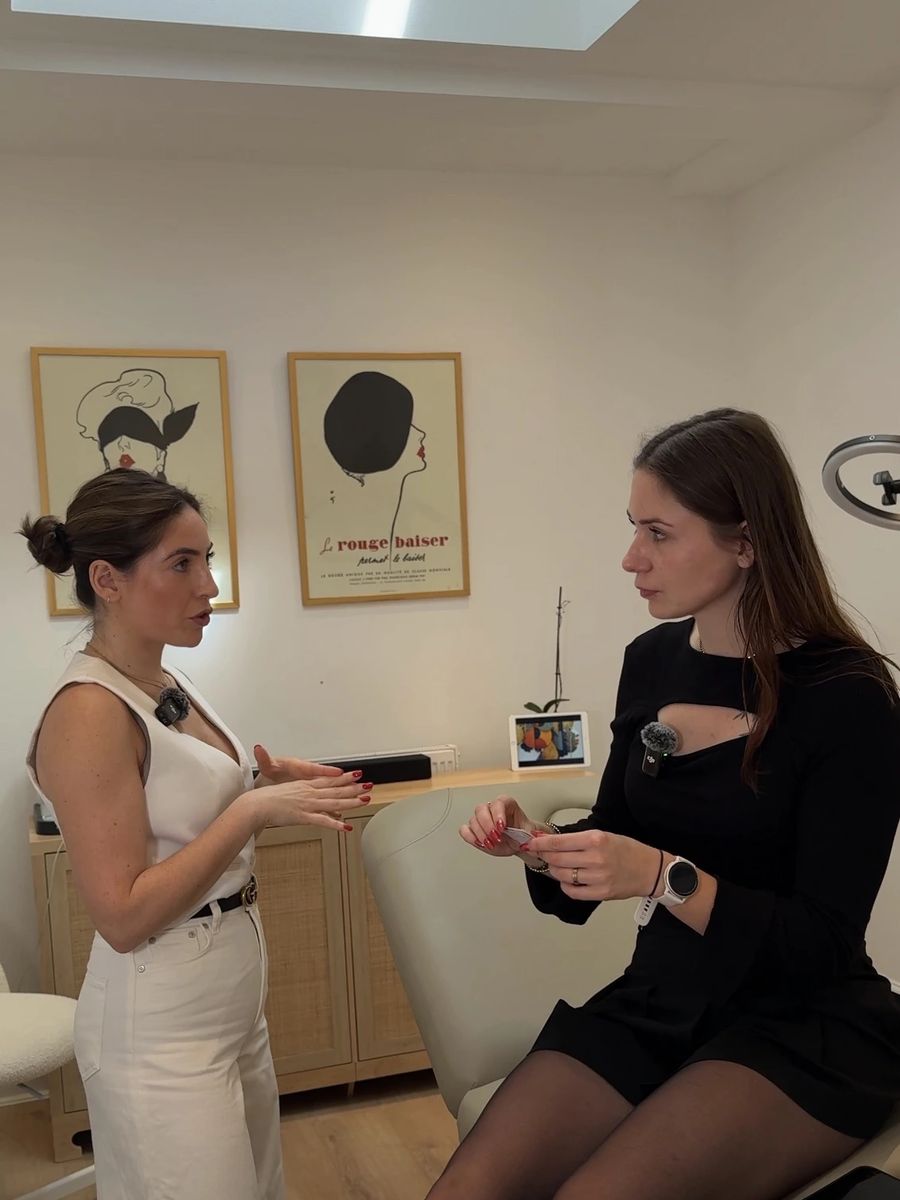
You do not need to arrive knowing which treatment to book. A professional consultation is where a considered assessment decides whether treatment should happen at all, what role it should play, and what may need attention first.

Georgina Sookias
Assessment-led skin specialist and facialist
In this guide
You know your skin looks congested, or dull, or uneven, and you are not entirely sure why. Someone has told you to book microneedling. Someone else suggested a peel, or Profhilo, or "just try a good facial." Your bathroom shelf holds three or four active products, bought at different times, for different reasons, that may or may not work well together. You have possibly already chosen a treatment based on what worked for someone else, or what was trending, without anyone actually looking at your skin as a whole.
This is the situation a professional skin consultation is built to address. It is not a formality you sit through before being sold a treatment. It is the stage where an assessment is made about whether treatment should happen at all, what role it should play if it does, and what might need attention first. Sometimes that means confirming the treatment you already had in mind. Sometimes it means recommending something different. Occasionally, it means recommending nothing yet.
What is a professional skin consultation?
A professional skin consultation is a structured assessment and planning appointment. It is not a brief chat before a facial begins, and its purpose is not to hand you a label or a diagnosis.
The aim is to understand several things at once: the visible condition of your skin, your relevant history, your current routine, what treatments are actually suitable for you, what you are hoping to achieve, and how realistic that is given your skin's starting point.
It helps to separate five different things that often get blurred together:
- What you notice. The concern that brought you in, described in your own words.
- What can be observed. The visible signs a trained eye can identify, which are not always the same as what you first pointed to.
- What may be contributing. Products, habits, previous treatments or lifestyle factors that could be feeding the concern.
- What requires medical diagnosis or referral. Anything that falls outside cosmetic skin assessment and needs a GP, dermatologist or other appropriate professional.
- What can appropriately be addressed through cosmetic skincare and professional treatment. The part that a consultation is actually designed to plan for.
Confusing these categories is where self-selected treatment often goes wrong. A consultation exists to sort them out first.
What happens in the room
A focused appointment that moves from listening, through assessment, to a plan you can actually follow.
We listen
You describe what's bothering you, in your own words, without needing to name a treatment first.
We review
Your current routine, previous treatments and relevant history are discussed in detail.
We assess
Georgina examines the visible condition of your skin as a whole, not just the area you mentioned.
We explain
You hear what has actually been observed, and why, in plain language.
We prioritise
Together, you identify what matters most to address first, and what can wait.
We create the plan
A personalised treatment and homecare plan is put together, built around what your skin actually needs.
We review progress
As your skin responds, the plan is revisited and adjusted where needed.
This does not reveal private clinical documentation, and no step implies a medical diagnosis.
Why should treatment begin with assessment rather than a menu?
A list of named treatments, however well presented, invites you to choose based on the name rather than the cause. That is a natural thing to do. It is also frequently the wrong starting point, because visually similar concerns can come from very different places.
Redness can be associated with genuine sensitivity, a disrupted skin barrier, recent over-exfoliation, heat, an active flare of something like rosacea, or an issue that needs medical assessment rather than a cosmetic treatment. Two people with the same flushed cheeks might need completely opposite approaches.
"Dry" skin is not always dehydrated in the way people assume. It might be lipid-deficient, genuinely dehydrated, irritated by an unsuitable cleansing routine, or some combination of all three. Treating dehydration when the real issue is barrier damage tends to make things worse, not better.
Congestion can mean blackheads, sebaceous filaments, inflammatory breakouts, product buildup, or a mixture. Each responds differently, and treating all congestion the same way is a common reason people feel stuck despite trying "everything."
Pigmentation does not have a single cause. Melasma and post-inflammatory pigmentation, for instance, do not behave like ordinary sun-related dark spots, and treating them identically can worsen the picture rather than improve it.
Texture issues might need barrier support first, a peel, microneedling, or genuinely nothing active yet. And laxity is not the same concern as surface quality, which is exactly why a facial, microneedling and a structural device like HIFU are not interchangeable answers to "my skin looks tired."
The point of all this is simple. Treatment names should come after assessment, not before it.
What is your skin showing you?
Open any concern to see how a single visible sign can have several possible causes, and why that shapes the conversation. This is educational only, not a diagnosis.
Congestion and visible pores
Blackheads, an uneven surface, or pores that feel more visible than they used to.
Why more than one factor may be involved: Congestion can involve sebaceous filaments, blackheads, product buildup, excess oil, or inflammatory breakouts, often in combination.
What Georgina would want to ask: What you currently use to cleanse, how often you exfoliate, and whether anything recent has changed your routine.
Why the visible concern does not automatically determine the treatment: The same surface appearance can call for very different first steps depending on the underlying cause.
Specific note: Active, painful or inflammatory breakouts are a reasonable reason to see a GP or dermatologist before cosmetic treatment.
Redness and sensitivity
Flushing, a stinging feeling, or skin that reacts easily to products or weather.
Why more than one factor may be involved: This may be associated with genuine sensitivity, barrier disruption, recent over-exfoliation, heat, or an active flare of something that needs medical attention.
What Georgina would want to ask: How long this has been happening, what you have introduced recently, and whether it comes and goes or is constant.
Why the visible concern does not automatically determine the treatment: Redness with different causes needs different, sometimes opposite, approaches.
Specific note: Persistent or unexplained redness is a reasonable reason to see a GP or dermatologist before any cosmetic treatment.
Dehydration and tightness
A tight feeling, fine dry lines, or skin that looks dull despite feeling oily in places.
Why more than one factor may be involved: This may be surface dehydration, a disrupted barrier, lipid deficiency, or a routine that is unintentionally working against your skin.
What Georgina would want to ask: What your current routine looks like, and whether you have added or removed anything recently.
Why the visible concern does not automatically determine the treatment: An exfoliating facial is not automatically the right answer for skin that feels dry.
Specific note: Severe or worsening irritation is worth having checked before introducing any further active treatment.
Dullness and uneven texture
Skin that looks tired, uneven, or lacks the light-reflecting quality it used to have.
Why more than one factor may be involved: Surface buildup, dehydration, barrier condition and cell turnover can all contribute differently.
What Georgina would want to ask: Your current exfoliation habits, sun exposure, and how your skin has changed over time.
Why the visible concern does not automatically determine the treatment: Texture can require barrier support, a peel, microneedling, or genuinely nothing active yet.
Pigmentation and dark marks
Dark patches, uneven tone, or marks left behind after a breakout.
Why more than one factor may be involved: Melasma, post-inflammatory pigmentation and ordinary sun-related marks do not behave the same way and should not be treated identically.
What Georgina would want to ask: When the marks appeared, whether they change with sun exposure or hormones, and your treatment history.
Why the visible concern does not automatically determine the treatment: Treating all pigmentation the same way can make some types worse, not better.
Specific note: Rapidly changing or irregular pigmentation should always be checked medically first.
Fine lines and changes in firmness
Lines at rest, or skin that feels less resilient or bouncy than before.
Why more than one factor may be involved: This can involve dehydration, skin quality, collagen and elastin condition, or genuine structural change, and these are not the same thing.
What Georgina would want to ask: Where the change is most noticeable, and what you have already tried.
Why the visible concern does not automatically determine the treatment: Facials, microneedling, Profhilo, polynucleotides and HIFU each address a different part of this picture.
Acne scarring
Textural changes, indentations or marks left after previous breakouts.
Why more than one factor may be involved: Scar type, depth and cause vary, and not every type responds to the same treatment.
What Georgina would want to ask: Whether you have any active acne currently, and details of previous scarring treatments.
Why the visible concern does not automatically determine the treatment: Active acne generally needs to be controlled before scarring is addressed, since treating scarring on inflamed skin can make things worse.
Specific note: Active, painful or inflammatory acne should be brought under control, ideally with appropriate input, before scarring treatment is considered.
Under-eye skin concerns
Fine lines, dullness, hollowing, or a tired appearance around the eyes.
Why more than one factor may be involved: This delicate area can be affected by dehydration, skin quality, volume loss, or simply the thinness of the skin there, and these need different responses.
What Georgina would want to ask: What has changed, and what you have already tried in this area specifically.
Why the visible concern does not automatically determine the treatment: Under-eye concerns are one of the more individually assessed areas of a plan, precisely because several different things can look similar here.
Specific note: Unexplained under-eye swelling or asymmetry should be checked medically, separate from ordinary tiredness or ageing changes.
A website cannot determine the cause of a skin concern. Sudden, persistent, worsening, asymmetric or otherwise unexplained changes should be assessed by an appropriate medical professional before cosmetic treatment is considered.
Same concern, different starting point
Select a client to see how the same everyday phrase can lead to a very different professional conversation.
This could be surface dehydration, a disrupted barrier, a routine containing too many active ingredients, lipid deficiency, environmental exposure, or another cause requiring medical assessment. An exfoliating facial is not automatically the right immediate answer.
This could be sebaceous filaments, blackheads, product buildup, excess oil, inflammatory breakouts, or irritation from over-cleansing. Aggressive extraction, steam or acids are not automatically the right response.
This could be temporary irritation, overuse of acids or retinoids, barrier disruption, heat or a recent treatment, an active flare, or persistent, unexplained redness requiring medical assessment. Georgina does not diagnose rosacea, eczema or dermatitis.
This could relate to surface dehydration, fine lines, skin quality, loss of elasticity, volume changes, deeper laxity, or facial anatomy. Facials, microneedling, Profhilo, injectable polynucleotides and HIFU do not perform the same role.
The purpose of these examples is not to diagnose your skin from a website. It is to show why the same phrase, said by two different people, can lead to two entirely different professional conversations.
Not sure where to start?
Tell me what is bothering you most and what you are hoping to change. I will point you in the right direction, honestly.
If I do not think you need treatment yet, I will tell you.
Message Georgina on WhatsAppWhat Georgina asks about during the consultation
A large part of the consultation is conversation, and it can feel more detailed than people expect. That level of detail is not idle curiosity. It is what prevents an unsuitable treatment from being recommended, and it is what makes a plan something you can realistically follow rather than something that looks good on paper.
Georgina will typically cover:
- Your primary concerns, and how long they have been present
- What has changed recently, if anything
- Previous professional treatments, and how your skin responded to them
- Any previous reactions or complications
- Your current skincare, including cleansers, moisturisers and SPF habits
- Any retinoids, exfoliating acids, vitamin C or other active ingredients you use
- Prescription skincare, where relevant
- Allergies and known sensitivities
- Medication and health history relevant to treatment safety
- Pregnancy or breastfeeding, where relevant
- A history of cold sores
- Any history of abnormal or keloid scarring
- Recent use of isotretinoin
- Recent sun exposure or tanning
- Lifestyle factors that might affect your skin or its ability to recover
- How much downtime you realistically have
- Your budget and your willingness to commit to homecare
- What result you are hoping for, and whether that expectation is realistic given your skin
None of this is invasive for its own sake. It is the information that separates a treatment that suits your skin from one that simply suits the calendar.
What Georgina looks at when assessing the skin
Alongside the conversation, there is a visual and tactile assessment of the skin itself. This covers:
- Barrier condition
- Dehydration
- Surface oil
- Congestion
- Inflammatory activity
- Sensitivity and visible redness
- Texture
- Pore visibility
- Pigmentation patterns
- Fine lines
- Overall skin quality
- Firmness and laxity
- Scarring
- Any areas that may need caution or medical assessment rather than cosmetic treatment
This is a professional cosmetic assessment, not a medical diagnosis. It is also an assessment of your skin as a whole, not just the one area you came in wanting to discuss. It is fairly common for something you had not mentioned to turn out to be more relevant to your plan than the concern you booked for.
Why the skin barrier may need attention first
The skin barrier is primarily associated with the stratum corneum, the outermost part of the epidermis. It helps limit water loss and protects the skin from external irritants. When it is working properly, you tend not to think about it. When it is compromised, almost everything else becomes harder to treat.
Aggressive cleansing, frequent use of acids, retinoids, physical scrubs, and layering several active ingredients at once can all contribute to a barrier that is irritated rather than resilient. This matters because more treatment is not automatically the answer to skin that already feels reactive. In some cases, a peel or a microneedling session is better postponed until the skin is calmer and more stable, not because the treatment itself is wrong, but because it is being asked to work on skin that is not ready for it.
Preparing the barrier with the right homecare is not a delay before "real" treatment starts. It is often an active and necessary part of the plan itself. SPF, in particular, matters both before and after most professional treatments, since treated skin is generally more vulnerable to UV damage while it recovers.
How Georgina decides what a personalised plan may include
This is not a menu, and it should not be read as one. The following are examples of the different roles a treatment might play within a protocol, not a list you are expected to choose from yourself. Some clients need one of these. Some need several, in sequence. Some need almost none of them, at least to begin with.
Preparing and refining the surface
This stage might include thorough but appropriately gentle cleansing, dermaplaning where suitable, or a carefully selected professional chemical peel. Extractions may form part of this too, where appropriate. Steam, acids and extraction are not used automatically on every client. The strength of any peel or exfoliation should be matched to what the skin can currently tolerate, not to what a client feels they should be able to handle.
Encouraging renewal
Professional microneedling works by creating controlled micro-channels in the skin, prompting its own repair process. It may be considered for texture, the appearance of some types of scarring, or general skin condition, with depth and treatment area chosen individually. Active inflammatory or infected acne is a recognised reason to avoid microneedling until it has settled. Microneedling is not automatically a stronger or better choice than a peel or a facial. It depends on what the skin actually needs.
Supporting the skin around professional treatment
After more active steps, attention often shifts to helping the skin settle. Calm, non-abrasive options such as LED or photobiomodulation may be used, sometimes alongside a suitable topical professional formula, including a topical PDRN or a professional exosome formulation where appropriate. Its role within a wider plan depends on the condition of the skin and what has been performed beforehand.
Improving hydration and overall skin quality
Profhilo and injectable polynucleotides are separately assessed injectable treatments that may form part of a wider skin programme. They are not casual additions to a facial appointment. Each requires its own suitability screening, informed consent, appropriate timing and aftercare. Neither is automatically the "better" choice. The right one, if either, depends on the individual assessment.
Addressing structural concerns
Ultraformer III HIFU works at a different tissue depth than surface-level facials or skincare. It may be considered where firmness or structural laxity, rather than surface texture or hydration, are the priority. HIFU is not a substitute for addressing congestion, dehydration or a compromised barrier, and it is not suitable for everybody.
Maintaining progress at home
Homecare is not an afterthought. A suitable cleanser, appropriate moisturising and barrier support, daily SPF, and carefully chosen active ingredients, introduced gradually rather than all at once, tend to matter more to long-term results than any single in-clinic treatment. Expensive does not automatically mean appropriate, and a routine that fights itself with too many actives can undo the benefit of professional treatment.
What is the difference between PDRN, exosomes and injectable polynucleotides?
These terms come up constantly online, and it is easy to assume they all mean roughly the same thing. They do not. The material, how it is formulated, how it is delivered, and the role it plays within a treatment plan can all differ significantly. Select each below for the full explanation.
PDRN stands for polydeoxyribonucleotide, a material made up of purified DNA fragments. It has a longer history as an injectable ingredient used in wound-healing and regenerative medicine settings, and more recently has appeared in topical cosmetic formulations too.
Topical PDRN and injectable PDRN are not automatically the same product, and they are not interchangeable. Evidence from injectable PDRN or injectable polynucleotides should not automatically be applied to topical cosmetic formulas. Evidence for topical use is still developing, and the relevance of any formula depends on the exact product, its documentation and how it is used within the professional protocol. Injectable PDRN has a more established evidence base for specific uses, though even there, published reviews have flagged inconsistencies across studies and called for more long-term safety data.
Where a topical PDRN formula is used within one of Georgina's protocols, it is one possible component chosen for a specific role, not a standard addition to every plan and not a miracle ingredient.
- What the term means
- PDRN stands for polydeoxyribonucleotide, a material made up of purified DNA fragments.
- How Georgina may use it
- As one possible topical formula within certain professional protocols.
- Topical or injected
- Topical only, in this context.
- Where it may fit within a plan
- As a supportive element, chosen for a specific role, not a standard addition to every plan.
- What it should not be confused with
- Injectable PDRN or injectable polynucleotides, which are different products with a different evidence base.
- What to ask before treatment
- What formulation is being used, and why it has been chosen for your specific plan.
Exosomes are naturally occurring extracellular vesicles involved in how cells communicate with each other. "Exosome treatment" is not one single, standardised product or procedure. The source of the exosomes, how they are formulated, the quality control behind them, and how they are applied all vary considerably between products marketed under the same name.
Rather than relying on any single regulatory claim, the more useful question is whether a product's source, formulation, documentation and method of use have been properly considered. The professional exosome formulation used within Georgina's protocol is applied topically as part of a defined protocol. It is not injected. The wider protocol can include a concern-specific peel, professional microneedling, a topically applied exosome formula, a concern-specific serum, and a selected light-based programme, brought together around one of several concern-led pathways: Wrinkle Renewal, Blemish Control, Dark Spot Correction, or Redness Recovery. You are not expected to choose your own formula or serum in advance.
- What the term means
- Exosomes are naturally occurring extracellular vesicles involved in cell-to-cell signalling.
- How Georgina may use it
- As a topical formula within a defined protocol, chosen according to a specific concern-led pathway, one of Wrinkle Renewal, Blemish Control, Dark Spot Correction or Redness Recovery.
- Topical or injected
- Topical only. Georgina's approved formulation is not injected.
- Where it may fit within a plan
- As part of a wider protocol that may also include a concern-specific peel, microneedling, a serum and a light-based programme.
- What it should not be confused with
- Injectable treatments, or the assumption that all exosome products are equivalent. Source, formulation, documentation and quality can vary considerably between products marketed using exosome-related terminology.
- What to ask before treatment
- How the product's source and formulation have been documented, and how it has been selected for your concern.
Injectable polynucleotides are, as the name suggests, injectable treatments, not topical serums. They require their own suitability assessment, informed consent, injection technique and aftercare, entirely separate from anything applied topically.
PDRN and the broader category of polynucleotides do overlap scientifically to some degree, but that overlap does not mean every topical PDRN product and every injectable polynucleotide product are the same treatment, or that one can simply be substituted for the other. The question worth asking is not "which ingredient is best." It is: what does my skin actually need, how should that be delivered, and where does it belong within the wider plan.
- What the term means
- Injectable treatments using polynucleotide material, requiring their own suitability assessment.
- How Georgina may use it
- Following a separate injectable assessment, consent process and aftercare plan.
- Topical or injected
- Injected.
- Where it may fit within a plan
- For suitable facial, under-eye, ageing, skin-quality or selected scarring concerns.
- What it should not be confused with
- Topical PDRN or topical exosome-based formulas, which are applied to the surface and not injected.
- What to ask before treatment
- What specific injectable product is being used, why it is appropriate for this treatment area and concern, and where it fits within the wider plan.
| Question | Topical PDRN | Exosome-based formula | Injectable polynucleotides |
|---|---|---|---|
| How is it used in Georgina’s relevant protocol? | Applied topically | Applied topically | Injected |
| Is it automatically the same as the others? | No | No | No |
| Does it require a separate injectable assessment? | Not as a topical formula | Not as a topical formula | Yes |
| Is it automatically right for every client? | No | No | No |
| Who selects it? | Georgina | Georgina | Georgina following separate assessment |
Skin terminology, explained
A short, plain-language glossary of the terms used above. Tap any term to expand its definition.
Primarily the stratum corneum, the outermost part of the skin. It helps limit water loss and protects against irritants. When it is compromised, skin tends to become reactive and harder to treat.
The outer layer of the skin, which includes the stratum corneum barrier and is responsible for constant cell renewal.
The layer beneath the epidermis, containing the collagen and elastin that give skin its firmness and its ability to spring back.
The skin's response to irritation or injury, which can appear as redness, heat or sensitivity. Active inflammation is often a reason to postpone certain treatments.
Areas of darker tone in the skin. Different types, such as melasma, post-inflammatory pigmentation and sun-related marks, behave differently and are not treated identically.
A professional treatment that creates controlled micro-channels in the skin, prompting its own repair process.
A calm, non-abrasive light-based option that may be used to support the skin, often after more active treatments.
Polydeoxyribonucleotide, a material made up of purified DNA fragments. It may be used topically within some professional protocols; topical and injectable forms are not the same.
Injectable treatments that require their own suitability assessment, consent and aftercare, separate from anything applied topically.
A professional topical formula. Exosomes are naturally occurring extracellular vesicles involved in cell-to-cell signalling; products vary considerably, and in Georgina's protocol they are applied topically, not injected.
A treatment that works at a different tissue depth from surface facials or skincare, sometimes considered where firmness or structural laxity is the priority.
Ingredients such as retinoids, exfoliating acids and vitamin C. Using too many at once can irritate the skin and work against professional treatments.
Professional consultation versus choosing a standard spa facial
This is worth addressing honestly, because the two are not the same thing, and neither is automatically better for every purpose.
A relaxation or spa facial has real value. It can be genuinely enjoyable, offer temporary hydration and a good massage, and serve as a pleasant piece of general maintenance and self-care. There is nothing wrong with choosing one for exactly those reasons.
The difference matters when someone is dealing with something more specific: persistent congestion, pigmentation, scarring, sensitivity, visible ageing changes, a reaction to a previous treatment, or a skincare routine that has become complicated and possibly counterproductive. In those situations, a longer-term, more detailed plan tends to serve you better than a single named facial.
A menu-led journey typically looks like choosing a named facial, receiving broadly the same sequence every time, being offered upgrades, and leaving with general product recommendations.
An assessment-led journey looks like discussing your concerns, history and routine in detail, assessing the visible condition of your skin, identifying priorities and any limitations, deciding whether your skin is ready for treatment at all, selecting or specifically excluding certain approaches for a stated reason, planning the timing between treatments, coordinating your homecare with what happens in-studio, and reviewing how you respond so the plan can adapt.
Neither path is wrong for what it sets out to do. They are simply designed to achieve different things.
When Georgina may recommend no treatment yet
This matters for trust, so it is worth being direct about it. There are situations where postponing or declining a treatment is the most responsible outcome of a consultation, not a disappointing one.
These include active inflammatory or infected acne, an active cold sore or other skin infection, open wounds or sunburn, significantly irritated or unstable skin, an active flare of eczema, psoriasis, dermatitis or rosacea, recent use of isotretinoin, a recent laser, resurfacing, peel or other treatment affecting the same area, a medication or health condition that requires additional caution, unexplained or persistent skin changes that genuinely need medical assessment, a heavily overloaded or irritating skincare routine, expectations that are not realistic for what treatment can achieve, or a concern that sits outside the professional scope of a skin specialist and facialist.
None of this involves Georgina making a medical diagnosis. It involves recognising when something needs a different kind of professional attention first, or simply needs time, before cosmetic treatment is appropriate.
What should happen next?
A consultation resolves to one of three honest outcomes, each based on professional judgement rather than a sale.
Treatment is appropriate
Georgina may recommend the appropriate first professional stage, and explain how it fits into your wider plan.
Your skin needs preparation first
This might mean simplifying your current products, giving extra attention to your skin barrier, reinforcing daily SPF, or allowing your skin to settle before anything more active begins. Preparation is an active part of the plan, not a delay.
Your concern needs medical assessment
Occasionally, the most useful outcome of a consultation is recognising that something sits outside cosmetic treatment altogether. Where that is the case, Georgina will say so directly and may suggest you see a GP, dermatologist or other appropriate professional.
Will treatment happen during the consultation?
No. The Personalised Skin Consultation is a separate 30-minute appointment dedicated to assessment and planning. No treatment is included within it. If a treatment is appropriate, it is booked as its own appointment, and Georgina may recommend homecare preparation, or another step first, before any procedure takes place.
On the practical side: the consultation is £50, paid in full at the time of booking. It is non-refundable, since it covers Georgina's time, expertise and the assessment itself. The full £50 can be redeemed against an eligible skin treatment or programme priced at £250 or more, provided it is booked within 14 calendar days of the consultation, though the treatment appointment itself can take place later. It is not redeemable against Korean Lash Lift, brow treatments, retail products or standalone LED sessions. If no treatment is booked, or none is considered suitable, the consultation remains a paid professional service.
What should you leave a professional skin consultation understanding?
By the end, you should have a clear sense of what has actually been observed about your skin, what the initial priorities are, and anything that should be avoided for now. You should understand whether your skin needs preparation before anything else happens, which treatment roles may genuinely be appropriate for you, and just as importantly, which have been ruled out and why.
You should also leave with an idea of how professional treatment and homecare are meant to work together, the likely sequence of what comes next, how progress will be reviewed, and a realistic sense of the limitations involved. The proposed investment should be clear before you commit to anything.
Questions to ask before booking a skin consultation elsewhere
Wherever you choose to go, these are reasonable questions to expect a straightforward answer to:
- Will my current routine and treatment history actually be reviewed?
- Will contraindications and any previous reactions be discussed with me?
- Can the practitioner explain why a particular treatment is being recommended?
- Will they tell me directly if a treatment is not suitable for me?
- Are treatment timing and recovery discussed in advance?
- Are any recommended products explained, with a clear reason attached?
- Is there an actual plan for reviewing how I respond?
- Are concerns outside their scope referred to the right kind of professional?
- Am I being properly assessed, or simply being sold the treatment I asked about when I booked?
Begin With Your Skin, Not a Treatment Name
A good consultation might confirm the treatment you had in mind, point you somewhere different, or suggest doing less for now. You do not need to know which treatment to book, begin with a professional assessment and let the plan come afterwards.
Book a Personalised Skin ConsultationFrequently Asked Questions
Georgina Sookias
An Advanced Skin Specialist & Facialist with 25 years of experience in the beauty industry and a Qualifi Level 7 Certificate in Aesthetic Practice, an Ofqual-regulated qualification. Georgina works on an assessment-led basis at South Park Studios in Fulham, London, building personalised treatment and homecare plans rather than selling isolated treatments.
Read more about GeorginaSources and further reading
- Colangelo MT, Galli C, Guizzardi S. "The effects of polydeoxyribonucleotide on wound healing and tissue regeneration: a systematic review of the literature." Regenerative Medicine. 2020;15(6):1801–1821. DOI: 10.2217/rme-2019-0118
- Lampridou S, Bassett S, Cavallini M, Christopoulos G. "The Effectiveness of Polynucleotides in Esthetic Medicine: A Systematic Review." Journal of Cosmetic Dermatology. 2025;24(2):e16721. DOI: 10.1111/jocd.16721
- Wang J, Yuan S, Tu Y, Lv Z, Cheng H, Ding X. "Extracellular vesicles in skin health, diseases, and aging." Interdisciplinary Medicine. 2024;2(3):e20240011. DOI: 10.1002/inmd.20240011
- Antonio CR, Tridico LA. "Exosomes in dermatology: A review of their role in skin diseases and rejuvenation." Surgical & Cosmetic Dermatology. 2024;16. DOI: 10.5935/scd1984-8773.2024160324
- "Microneedling." StatPearls (NCBI Bookshelf). Available at: ncbi.nlm.nih.gov/books/NBK459344
- CLASSYS. "Ultraformer III." Official product website. ultraformer.com
This article is for educational purposes only and does not constitute medical advice or diagnosis. A professional skin consultation is a cosmetic assessment. Where a concern requires medical attention, please consult a GP, dermatologist or other appropriate professional.