By Georgina Sookias, Advanced Skin Specialist & Facialist
Skin Education · Timing & recovery
How Often Should You Have a Facial?
"Every four to six weeks" is the answer most people expect before they’ve even asked the question. It’s a commonly repeated guideline, not a universal rule, and treating it as one can mean booking more often than your skin actually needs, or leaving it later than would genuinely help. The honest answer is less tidy than a fixed number, but it’s the one that actually serves your skin.
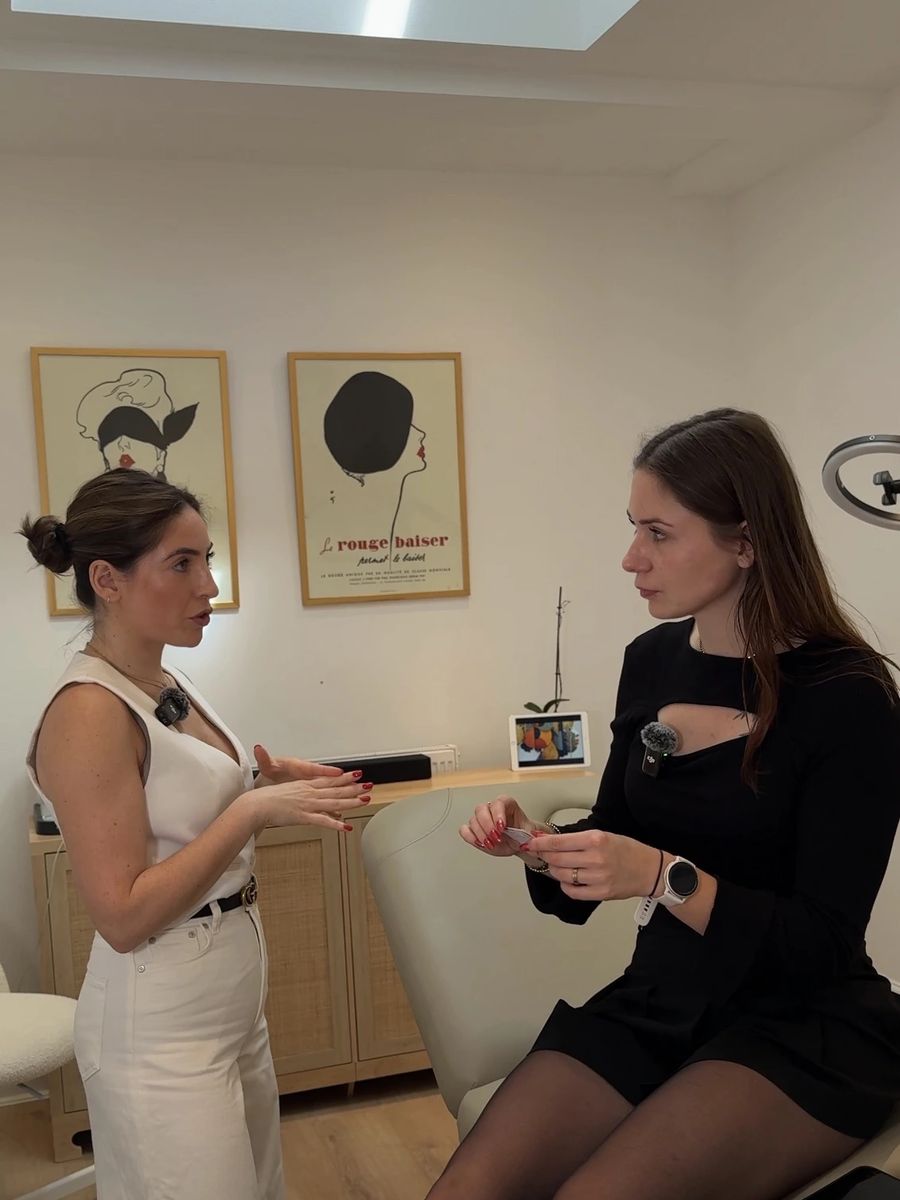
Georgina consulting with a client at the Fulham studio.
The short answer
There is no single facial schedule that suits everybody. Some people benefit from occasional maintenance, while others may follow a more structured programme for a defined period. The appropriate interval depends on your skin, the treatment performed, recovery and the reason for having the facial.
The tidy answer everyone expects
Why there is no universal monthly rule
There’s nothing wrong with "every four to six weeks" as a starting reference point. The problem is treating it as a fixed prescription that applies the same way to every skin, every treatment, and every goal. A facial supporting generally healthy skin, a facial that’s part of an active programme addressing congestion, and a facial planned around an event next week are not the same decision, and they shouldn’t follow the same calendar.
The 28-day myth
What skin renewal tells you, and what it doesn’t
You may have heard that skin "renews itself" on a set cycle, often quoted as 28 days. Skin renewal is genuinely continuous, but it doesn’t run on one universal timetable that converts directly into a facial schedule. Published estimates of how long epidermal renewal actually takes differ according to the body site being measured, the method used to measure it, and which stage of renewal is being counted, the journey through the living layers of the epidermis, the surface layer alone, or the whole process combined. Even the site matters more than people assume: facial skin and skin elsewhere on the body don’t renew at the same rate. None of this means the concept is unreliable. It means a single borrowed number was never a safe way to plan a facial calendar, and this article doesn’t use one.
The real variables
What actually determines your interval
Several things genuinely decide how often a facial makes sense for you, and none of them work in isolation, from the current condition of your skin and its barrier health, to what a professional facial actually does and how you’ve recovered since. The full picture is set out below.
Congested, sensitised, or generally settled skin each call for a different rhythm, not the same fixed interval.
A barrier still recovering from a previous treatment or an aggressive routine needs longer before the next active step.
A calming, hydration-focused facial and one including a stronger peel don't carry the same recovery need.
Even within "a facial," intensity varies considerably from one appointment to the next.
How your skin actually responded matters more than how long the calendar says it's been.
What you're doing at home between appointments changes how much your skin can handle in the studio.
Occasional maintenance and a defined programme working toward a specific concern are different undertakings.
These genuinely run on different cadences, and knowing which one you’re doing changes the right interval.
A skin barrier that hasn’t recovered from one appointment doesn’t respond well to another one arriving too soon. Over-treating in the name of "faster results" tends to produce the opposite: more sensitivity, more reactivity, and skin that takes longer to settle, not less. This is the same principle already true of over-exfoliating or layering too many active ingredients at home, applied here to frequency rather than product use.
Two different rhythms
Maintenance versus a structured programme are different cadences
A facial that supports skin that’s already in reasonably good condition runs on a very different rhythm from one that’s part of a structured programme working toward a specific goal. Confusing the two is one of the most common reasons people either over-book or under-book relative to what their skin actually needs. The comparison below sets out how each actually differs.
Maintenance may look like
Supporting skin that's already in reasonably good condition
A flexible interval, not a tight schedule
Stretching the gap usually isn't a problem
No fixed end point
A structured programme may look like
Working toward a specific, defined concern
A planned interval, reviewed as it goes
A defined period, not an indefinite routine
Adjusted based on how the skin responds along the way
Not sure whether your skin needs maintenance or a structured plan? That’s exactly what a consultation is for.
Signs your skin needs a longer gap, and when a shorter interval may be considered
Recovery isn’t always obvious from the calendar alone. Persistent sensitivity, ongoing irritation, or a barrier that hasn’t settled since your last appointment are all reasonable signs the next one should wait. A shorter interval, by contrast, is Georgina’s call to make, not something to self-assess at home, based on how the previous treatment was tolerated and how the skin has actually responded since. The full breakdown of both sides is below.
These are the factors Georgina reviews before adjusting your interval. This isn’t a self-check; it’s what an assessment actually looks at.
What you may notice
Persistent sensitivity after your last appointment
Ongoing irritation that hasn't settled
A barrier that hasn’t recovered since the previous visit
What Georgina professionally assesses
How the previous treatment was tolerated
How well the skin recovered
Current barrier condition and sensitivity
What homecare has been doing between appointments
The actual purpose of the programme you’re on
Persistent, worsening or otherwise unexplained irritation should be assessed by an appropriate medical professional rather than assumed to be normal post-facial recovery.
Not the same clock
Why treatment-specific spacing is different from facial spacing
Professional peels, microneedling, and other advanced treatments each carry their own required interval, set by the specific device, its settings, the treatment area, and how your skin responds, not by general "how often should I have a facial" logic. This article doesn’t state numbers for those intervals, because a safe number depends entirely on specifics this article can’t know about your situation. If you’re planning one of these treatments, the relevant treatment page and your consultation with Georgina are where that specific guidance lives, not a general frequency article.
Injectable treatments such as Profhilo, and structural treatments like HIFU, sit entirely outside facial-frequency thinking. They’re separately assessed, with their own protocols and their own timelines, and they’re never scheduled by the same logic as a facial.
Assessed, then reviewed
How Georgina decides your interval
Your interval isn’t set once and left alone. It begins with a professional skin consultation, where Georgina assesses what your skin actually needs, then reviews and adjusts the plan as your skin responds. What’s right for your first appointment may not be right for your fourth.
Good to know
Frequently Asked Questions
There's no single answer that applies to everyone. It depends on your skin's current condition, what treatment is being performed, how you've recovered from previous appointments, and whether you're maintaining generally healthy skin or working through a structured programme.
No. Monthly is a commonly repeated guideline, not a requirement. Some skin does well with a longer gap; some structured programmes call for a shorter one. The right interval is decided based on your skin, not a fixed calendar.
Yes. A skin barrier that hasn't recovered from one appointment doesn't benefit from another arriving too soon. More frequent isn't automatically better, and over-treating can produce more sensitivity and slower recovery, not faster results.
Persistent sensitivity, ongoing irritation, or skin that still feels unsettled since your last appointment are signs recovery isn't complete. If you're unsure, this is exactly what Georgina reviews before your next appointment.
Often, yes, though this depends on what’s causing the sensitivity and how your skin is presenting at the time, which is assessed individually rather than assumed from "sensitive skin" as a general label.
Yes. Maintenance supports skin that's already in reasonably good condition and doesn't need a tight schedule. A structured programme works toward a specific goal over a defined period and is planned and reviewed as it goes.
This depends on your specific routine, your skin's tolerance, and what the facial involves, so it's assessed individually rather than answered with a blanket yes or no.
Microneedling, professional peels and other advanced treatments require their own treatment-specific spacing. The appropriate interval depends on the device, intensity, treatment area, skin response and recovery, so Georgina provides individual guidance rather than applying one general facial timetable.
Age can be one factor among several, since some measures of skin renewal suggest it can slow over time, but it doesn't determine your interval on its own. Skin condition, goals and recovery matter more than age alone.
At consultation, based on an assessment of your skin, then reviewed and adjusted as your skin responds over time. It isn't fixed at the first visit and left unchanged.
Reviewed as your skin changes
Your interval isn’t a fixed number. It’s a decision made about your skin, and reviewed as your skin changes.
Georgina Sookias is an Advanced Skin Specialist & Facialist with a Qualifi Level 7 Certificate in Aesthetic Practice and 25 years of experience in the beauty industry. Based at South Park Studios, Fulham, London.
Weinstein GD, Van Scott EJ. "Autoradiographic analysis of turnover times of normal and psoriatic epidermis." Journal of Investigative Dermatology. 1965;45(4):257-262. PMID 5837896 — cited for the original measurement underlying commonly repeated epidermal turnover figures, and for the finding that turnover time varies depending on which stage of renewal is measured.
Bergstresser PR, Taylor JR. "Epidermal ‘turnover time’ — a new examination." British Journal of Dermatology. 1977;96(5):503-506. DOI: 10.1111/j.1365-2133.1977.tb07152.x — cited for the finding that measurement method itself affects the resulting turnover-time estimate.
Epstein WL, Maibach HI. "Cell renewal in human epidermis." Archives of Dermatology. 1965;92:462-468 — cited for the finding that turnover rate differs by body site, including a documented difference between facial and other skin.
Grove GL, Kligman AM. "Age-associated changes in human epidermal cell renewal." Journal of Gerontology. 1983;38(2):137-142. DOI: 10.1093/geronj/38.2.137 — cited for the narrow finding that measured stratum-corneum transit time was longer in the older group studied. Not cited as, and does not support, a universal age-based facial timetable.
Iizuka H. "Epidermal turnover time." Journal of Dermatological Science. 1994 Dec;8(3):215-217. PMID: 7865480. DOI: 10.1016/0923-1811(94)90057-4 — cited for the finding that total epidermal turnover time is the sum of separate proliferative, differentiated and stratum corneum compartment times, and that recalculating with Weinstein’s later data gives a total closer to 47-48 days rather than 39 days, directly supporting the article’s point that published estimates vary according to what is measured and which data they draw on.