Exosomes vs Polynucleotides: Which Is Better for Your Skin? (2026 Honest Guide)
Quick answer
Exosomes and polynucleotides are both regenerative skin treatments but they work in fundamentally different ways. Exosomes are cellular messengers that signal the skin to repair and regenerate. Polynucleotides are DNA-derived structural repair molecules that directly rebuild and strengthen skin tissue. They target different mechanisms, suit different concerns, and in many cases work best when used together.
Neither is universally better. The right choice depends entirely on what your skin needs.
On this page
Two of the most confused treatments in aesthetics
Two of the most searched treatments in regenerative aesthetics right now. Two treatments that sound similar, often appear on the same clinic menus, and are frequently confused with each other. And almost nobody is explaining the actual difference clearly.
This is one of the most common conversations I have with clients at my Fulham clinic right now. It is worth having properly, because the difference between these two treatments matters a great deal when it comes to choosing the right one for your skin.
Many people spend years investing in facials, skin boosters, and expensive topical skincare while the underlying quality of their skin tissue continues to deteriorate. Regenerative treatments like exosomes and polynucleotides aim to improve the health of the tissue itself rather than simply masking the problem. That is the fundamental shift. But they do it in different ways, and understanding which way your skin actually needs is what this guide is for.
Most articles either collapse them into the same category, both regenerative, both good, or make one sound obviously superior to the other. Neither is accurate. This guide gives you the honest clinical picture. I use both treatments in my Fulham clinic. Here is exactly what each does, who it suits, where they differ, and when combining them produces better results than either alone.
What are exosomes?
Exosomes are microscopic extracellular vesicles, tiny structures naturally produced by cells. Think of them as biological messaging systems. They carry proteins, growth factors, lipids, and genetic material (including microRNA and messenger RNA) from one cell to another.
In skin terms, exosomes act as intelligent signals. When applied to the skin they communicate with your skin cells, triggering repair processes, stimulating collagen and elastin production, reducing inflammation, and accelerating healing.
In clinical aesthetics, exosomes are typically applied topically during or after microneedling, where the treatment channels created by the needles allow deep penetration into the dermis. They are not currently used as standalone injectable treatments in mainstream UK aesthetics.
Exosomes at a glance
- Source: derived from carefully sourced biological materials depending on the manufacturer and product
- Mechanism: cellular signalling, not structural repair
- Delivery: topical, applied during or after microneedling
- Results: accelerated healing, improved radiance, reduced inflammation, enhanced resilience
- Evidence base: strong for post-procedure healing and skin quality; still emerging for standalone use
At my Fulham clinic I use exosomes as part of microneedling with exosomes protocols, where the combination of mechanical stimulation from the needles and the signalling intelligence of the exosomes produces a genuinely powerful regenerative response.
What are polynucleotides?
Polynucleotides (PNs) are highly purified DNA fragments derived from salmon or trout. When injected into the skin, they act as a structural repair kit. They directly stimulate fibroblasts to produce collagen and elastin, attract and retain moisture within the dermis, strengthen the dermal matrix, and improve skin density over time.
Where exosomes tell cells what to do, polynucleotides give cells the materials and signals to rebuild.
Polynucleotides at a glance
- Source: purified salmon or trout DNA
- Mechanism: direct fibroblast stimulation and tissue repair
- Delivery: injectable (intradermal injection)
- Results: improved skin thickness, hydration, density, reduction in fine lines, under-eye rejuvenation
- Evidence base: strong and well-established, over 20 years of clinical research
I use two professional-grade polynucleotide products at my Fulham clinic: Vitaran (20mg/ml, Fox Pharma, UK-exclusive) and Plenhyage XL Strong (25mg/ml, Bioformula Italy, CE0373 Class III). You can read a full breakdown in my polynucleotides cost UK guide.
The core difference: messenger vs repair kit
This is the single most useful way to understand how these treatments differ:
Exosomes = the messenger
They carry instructions. They tell your skin cells to wake up, communicate, repair, and regenerate. They are particularly powerful at triggering a cascade of healing responses, especially in skin that has been stimulated by microneedling, laser, or other energy-based treatments.
Polynucleotides = the repair kit
They provide the raw materials and direct stimulation for structural rebuilding. They physically integrate into the tissue environment, attract water, activate fibroblasts, and support the scaffolding of healthy skin.
The reason combining them is so effective is that they work on different but complementary pathways. One sends the signal. The other provides the building blocks.
Side-by-side comparison
Not sure which column describes your skin? Send me a photo on WhatsApp and I will give you my honest assessment.
Get honest adviceAt a glance
Quick self-check: which treatment is right for you?
Not sure where to start? This is the fastest way to narrow it down.
Choose exosomes if
- Your skin looks dull, tired, or lacks radiance
- You have redness, rosacea, or post-acne inflammation
- You want faster visible improvement in skin quality
- You are recovering from or preparing for a more intensive treatment like microneedling or laser
Choose polynucleotides if
- Your skin feels thinner, less bouncy, or has lost density
- You have under-eye crepiness, hollowness, or dark circles from thin skin
- You want structural, long-term rebuilding that compounds over a course
- Acne scarring, deep textural damage, or photoageing is the primary concern
Choose both if
- You want the most comprehensive regenerative result available
- Your skin has multiple concerns spanning surface quality and deeper structural deterioration
- You are serious about long-term skin health rather than a single treatment fix
What each treats best
Exosomes are the stronger choice when
- You want to accelerate healing after microneedling, laser, or energy-based treatment
- Skin inflammation, rosacea, or post-acne redness is the primary concern
- You want rapid radiance and surface quality improvement
- You are preparing skin for or recovering from a more intensive procedure
- Your goal is overall cellular optimisation rather than targeted structural repair
Polynucleotides are the stronger choice when
- The concern is skin thinning, loss of density, or structural deterioration
- Under-eye hollowness, crepiness, or dark circles from thin skin are the priority
- You want a course of treatment with cumulative, long-lasting structural results
- Acne scarring, deep textural damage, or significant photoageing is the goal
- You prefer an injectable treatment with a longer-established evidence base
Where both work equally well
- General skin quality improvement and anti-ageing maintenance
- Sensitive or reactive skin that needs regeneration without aggression
- Clients who want to avoid filler or more invasive procedures
What this looks like in practice
Two typical client profiles I see regularly:
A client who suits exosomes first
Someone in their late 20s or 30s whose skin looks dull, feels reactive, and has not responded well to more aggressive treatments. They may have mild post-acne redness or rosacea. Their skin needs to be calmed, signalled back into healthy function, and given a repair boost. Microneedling with exosomes is the right starting point. Results come quickly and the skin responds visibly within a couple of weeks.
A client who suits polynucleotides first
Someone in their late 30s to 50s whose skin has thinned, lost bounce, or developed under-eye hollowness and crepiness. They want structural improvement that builds over time. Polynucleotides address the underlying tissue quality directly. This client often sees their best results after a full course of 3 sessions.
A client who suits both
Many clients benefit from a combined protocol: polynucleotides injected to rebuild structural tissue, and exosomes applied during a microneedling session to amplify the cellular signalling response. The two treatments target different mechanisms and stack cleanly without competing.
Real results · Regenerative aesthetics
Photos shared with patient consent.
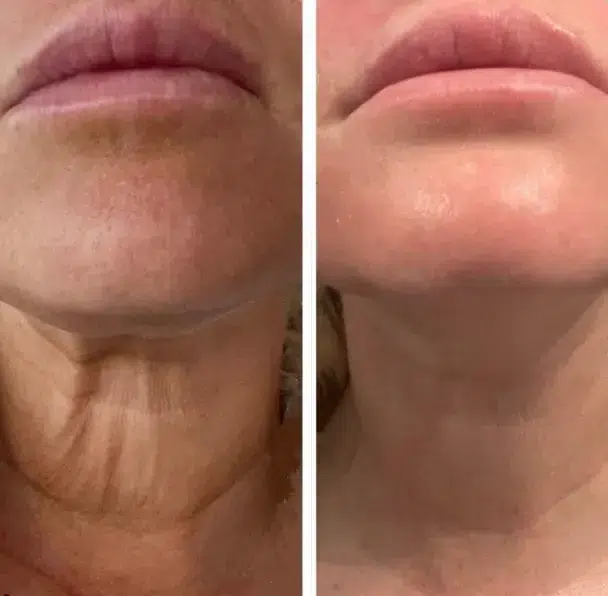
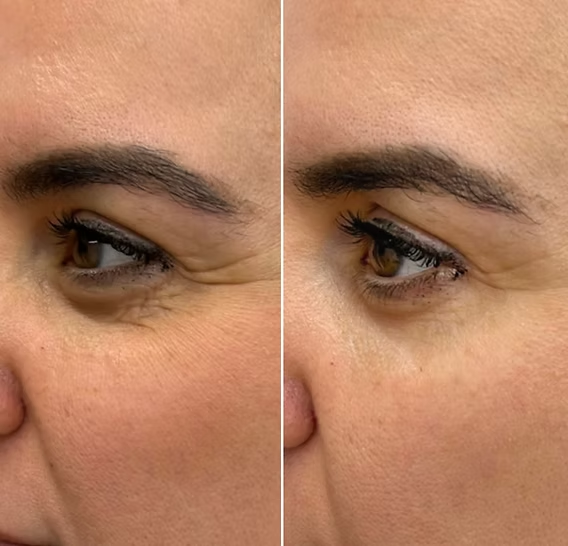
Results vary depending on skin quality, anatomy, age, lifestyle, and treatment history. The images reflect real client outcomes at my Fulham clinic.
Complimentary Red Light Therapy
Included at no additional cost with qualifying skin treatments.
All regenerative skin treatments at Georgina’s Fulham studio include complimentary professional Red Light Therapy.
Our professional system combines 630nm and 660nm red light with 810nm, 830nm and 850nm near infrared wavelengths. These wavelengths have been widely studied for their ability to support skin health, cellular energy production and collagen synthesis.
As part of our regenerative approach to skin health, we include professional Red Light Therapy after qualifying treatments to support the skin during the recovery phase and enhance the overall treatment experience at no additional cost.
This is provided complimentary with all qualifying skin treatments as part of our regenerative approach to skin health.
Learn more about red light therapyNot sure which approach?
Send me a photo on WhatsApp
I will tell you honestly whether exosomes, polynucleotides, or a combination would produce the best results for your specific skin and concerns.
Send a photo on WhatsAppWatch a Microneedling with Exosomes Treatment
Can you combine exosomes and polynucleotides?
Yes. This is increasingly considered the most effective regenerative protocol for clients with complex or significant skin concerns.
The combination works because:
- Polynucleotides rebuild and strengthen the dermal structure
- Exosomes amplify cellular signalling and accelerate the repair response
- Together they address both the structural and communication pathways of skin ageing simultaneously
A typical combined protocol might look like:
The exact protocol depends on your skin concerns and is determined at consultation.
The honest caveat on exosomes
Worth saying clearly because most clinic content skips this. Polynucleotides have over 20 years of clinical research behind them. The evidence base is robust.
Exosomes in aesthetic medicine are newer. The results are genuinely impressive and the science behind cellular signalling is well-established in medicine broadly. But long-term data specifically for cosmetic exosome use is still accumulating. Product quality and sourcing varies significantly between brands.
This does not mean exosomes are unsafe or ineffective. It means you should ask any clinic what product they use, where it is sourced, and what the evidence basis is for their specific protocol. At my clinic I use only CE-marked, professionally sourced exosome products with transparent ingredient provenance.
How I use both at my Fulham clinic
My approach is always led by what the skin actually needs rather than what is trending.
I start with polynucleotides when
- The skin needs structural rebuilding
- Under-eye rejuvenation is the primary goal
- The client wants a well-evidenced, established protocol
- It is a first regenerative treatment
I start with exosomes (via microneedling) when
- The skin is inflamed, reactive, or post-procedure
- Radiance and surface quality are the immediate priority
- The client wants faster visible results
- We are combining with a mechanical treatment like microneedling
My broader philosophy across all of these treatments is the same: regeneration before correction. Strengthening and rebuilding the skin's own capacity to function well produces more natural, longer-lasting results than layering volume or surface treatments over compromised tissue. You can read more on my polynucleotides Fulham page, and compare options in my polynucleotides vs Profhilo guide.
What would I choose if this were my skin?
People ask me this regularly. Here is my honest answer by age and concern.
Late 20s to early 30s, dull or reactive skin
Exosomes via microneedling first. Your skin is not structurally deteriorating yet. What it needs is better cellular communication, reduced inflammation, and a quality boost. Microneedling with exosomes produces visible results quickly and sets the foundation for everything else.
Late 30s, early signs of thinning or under-eye changes
Polynucleotides as the primary treatment, specifically Vitaran for under-eye work. This is when structural rebuilding starts to matter. The skin is thinning faster than you can feel it and polynucleotides address that directly. Add exosomes as an enhancement once the baseline course is complete. See my full guide on polynucleotides under eyes.
40s, more pronounced ageing or skin density loss
Plenhyage XL Strong for intensive structural repair, combined with exosomes in a microneedling session mid-course. This is where the combined protocol produces its most significant results. You are addressing both the structural deficit and the cellular communication breakdown simultaneously.
Post-acne scarring at any age
Start with exosomes to calm inflammation and improve cellular function, then layer in Plenhyage XL Strong for deeper tissue remodelling. The combination is significantly more effective than either alone for this concern.
What most clients actually choose
Honestly? Most clients who come to me for a regenerative consultation end up choosing a combination approach. Not because I push them toward it. But because once they understand how the two treatments work differently, it becomes clear that polynucleotides and exosomes are not competing options. They are complementary.
That said, budget is real and not everyone needs both from the start. If you are new to regenerative treatments and want to begin with one, I will always tell you honestly which is the better starting point for your specific skin and concerns.
Pricing at my Fulham clinic
For full UK pricing context, see my detailed guide on polynucleotides cost UK, or read exactly what microneedling with exosomes costs at my clinic. To explore the regenerative treatments directly, visit my microneedling with exosomes and polynucleotides Fulham pages.
Frequently asked questions
Regenerative aesthetics · Fulham SW6
Book a regenerative consultation in Fulham
My Skin Consultation is £50, redeemable against eligible treatments of £250 or more. I will assess your skin honestly and tell you whether exosomes, polynucleotides, or a combination would produce the best results for your specific concerns.
South Park Studios, 88 Peterborough Road, Fulham SW6 3HH
Serving clients across Fulham, Chelsea, Wandsworth, Battersea, Clapham, Putney and South West London.
Related treatments and reading
Polynucleotides in Fulham
Full treatment page and what to expect.
ViewMicroneedling with Exosomes
The regenerative microneedling protocol.
ViewPolynucleotides cost UK
Real UK pricing and which product is best.
ViewPolynucleotides under eyes
Dark circles and under-eye rejuvenation.
ViewPolynucleotides vs Profhilo
Which regenerative injectable suits you?
ViewHIFU Fulham
For structural lifting alongside regeneration.
ViewThis article is for informational and educational purposes only. It does not constitute medical advice. Always consult a qualified practitioner before starting any aesthetic treatment.